
Back to Blogs
AI Product Photography: Transform Flat Lay Images into Professional Model Photoshoots for Fashion E-Commerce
AI Product Photography: Transform Flat Lay Images into Professional Model Photoshoots for Fashion E-Commerce
Fashion e-commerce conversion rates depend on one critical factor: product photography quality. When customers cannot physically touch garments or try them on, visual presentation becomes the entire buying experience. A plain product photo might display what you sell, but premium on-model photography shows how it looks, fits, and transforms the wearer.
The challenge facing fashion brands is universal: professional model photoshoots cost thousands of dollars, require weeks of coordination, and demand complex logistics. For D2C fashion brands, online clothing stores, and marketplace sellers launching multiple collections annually, traditional photography creates an impossible bottleneck between product creation and market launch.
AI fashion photography technology now solves this challenge. Plain garment images transform into studio-quality model photoshoots within hours, delivering professional fashion e-commerce visuals without cameras, models, or production crews.
Why Fashion Brands Struggle with Traditional Product Photoshoots
The True Cost of Professional Fashion Photography
Professional fashion model photography requires substantial investment that extends far beyond photographer fees. A single-day photoshoot includes model agency costs, studio rental expenses, lighting equipment, makeup artists, styling teams, and post-production retouching.
Industry estimates place professional fashion photoshoot costs between $3,000 and $10,000 per session. This budget typically yields 20 to 30 finished images. Fashion brands managing 100-plus SKUs per season face $30,000 to $50,000 in product photography expenses alone.
Small fashion businesses and emerging D2C brands cannot sustain these costs. Many resort to flat lay photography or mannequin images that fail to showcase fit, drape, or real-world appeal. Conversion rates suffer when product images lack human context.
Time Delays That Kill Fashion Launch Momentum
Traditional fashion photoshoots demand extensive coordination. Booking models, securing studio space, coordinating styling teams, and scheduling post-production creates multi-week timelines. By the time product images are ready for website upload, trends may have shifted or competitor brands have captured market attention.
Fast fashion and seasonal collections require rapid time-to-market. Delayed product photography means delayed launches, missed revenue windows, and lost competitive positioning in crowded fashion e-commerce marketplaces.
Scalability Problems for Growing Fashion Catalogs
What works for 20 products becomes unmanageable for 200. As fashion catalogs expand, traditional photography logistics grow exponentially complex. Brands face difficult choices: limit product offerings, accept inconsistent e-commerce visuals, or allocate disproportionate budgets to content creation.
How AI Transforms Product Photos into Professional Model Images
AI Fashion Photography Technology Explained
Advanced AI product photography platforms analyze plain garment images and reconstruct them on photorealistic human models. The technology maintains perfect product accuracy while adding the human context customers need for confident purchase decisions.
The transformation process preserves every product detail: fabric texture, color accuracy, pattern alignment, stitching, and garment construction. Unlike manual photo editing or digital compositing, AI understands how clothing naturally drapes, folds, and fits on realistic body forms.
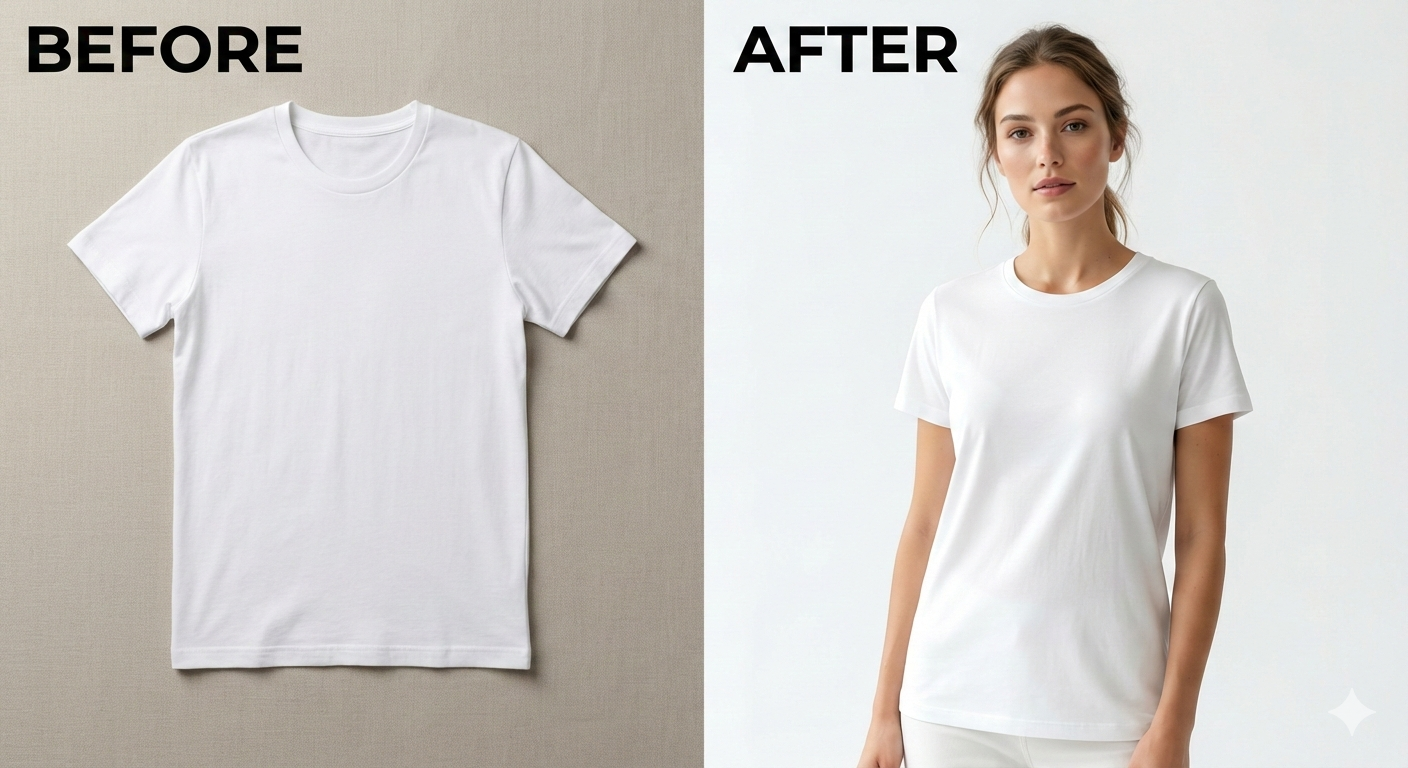
From Flat Lay to Fashion Model: The Visual Transformation
Before Transformation: A plain product photograph captures a garment on a hanger, flat surface, or basic mannequin. The image shows construction details but lacks human context. Online shoppers struggle to visualize fit, proportion, and styling possibilities on actual bodies.
After AI Processing: The identical product appears worn by a realistic model in a professional studio environment. Soft lighting showcases fabric texture and garment details. The model's natural pose demonstrates how the clothing moves and fits. Clean studio backgrounds ensure product focus while creating premium fashion e-commerce aesthetics.
This complete transformation happens without physical model photoshoots, casting sessions, or studio bookings. The entire process occurs digitally while maintaining photorealistic quality standards that match traditional fashion photography.
Studio-Quality E-Commerce Photography at Scale
Premium fashion e-commerce photography follows specific visual standards that define luxury brand aesthetics. Clean white or neutral studio backgrounds eliminate visual distractions. Soft, professional lighting highlights product features without harsh shadows or color distortion. Model poses feel natural, confident, and aspirational.
AI-powered fashion photoshoots replicate these professional standards consistently across unlimited images. Every generated photograph features identical high-resolution quality, lighting setup, and aesthetic approach. The result: cohesive brand visuals spanning entire product catalogs without the inconsistency that plagues traditional multi-session photoshoots.
Essential Elements of Premium AI Fashion E-Commerce Photography
Professional Studio Lighting for Product Photography
Lighting quality determines fashion photography success. Premium product images use soft, diffused studio lighting that eliminates harsh shadows while providing dimensional depth. This professional lighting approach highlights fabric details, reveals texture, and ensures accurate color representation that matches physical products.
AI fashion photography platforms replicate expert studio lighting automatically. Every generated model image features the same consistent, professional illumination that photographers spend years perfecting in physical studio environments.
Clean Studio Backgrounds for Fashion E-Commerce
Background selection impacts viewer focus and brand perception. Busy or distracting backgrounds pull customer attention away from products. Professional fashion brands consistently use clean studio backgrounds in neutral tones: pure white, light gray, or subtle gradients that complement modern website design.
This minimal aesthetic approach serves multiple strategic purposes. Clean backgrounds work seamlessly across website product pages, marketing materials, social media posts, and marketplace listings. They maintain brand consistency while ensuring products remain the clear visual priority in every e-commerce touchpoint.
Photorealistic Model Integration Without Physical Models
The success of on-model product photography depends entirely on visual realism. Obvious digital manipulation or artificial-looking compositing destroys customer trust and brand credibility. Advanced AI fashion photography technology generates models that appear genuinely human, with natural skin tones, realistic body proportions, authentic facial features, and appropriate poses for specific garment categories.
Products integrate seamlessly with AI-generated models. Clothing follows natural body contours and movement. Fabrics drape realistically according to textile physics. Construction details like buttons, zippers, seams, and hemlines align correctly with underlying garment structure.
Strategic Use Cases for AI-Generated Fashion Product Photography
Hero Images for Fashion E-Commerce Websites
First impressions determine bounce rates on fashion e-commerce websites. Hero images on homepages, category landing pages, and collection pages need immediate visual impact. Professional on-model photography creates this impact by presenting products in aspirational yet attainable contexts that resonate with target customers.
AI-generated hero images deliver premium fashion photography aesthetics at a fraction of traditional photoshoot costs. Fashion brands can refresh homepage visuals weekly or daily, testing different products, model demographics, and styling approaches without additional production expenses.
Product Listing Page Photography That Converts
Product detail pages serve one purpose: converting browsers into buyers. Multiple image angles, zoom capabilities, and contextual on-model photographs all contribute to conversion rate optimization.
Traditional fashion photography rarely provides sufficient image variety for every SKU due to time and budget constraints. AI product photography technology generates multiple on-model views for each garment, giving online shoppers comprehensive visual information that builds purchase confidence and reduces cart abandonment.
Fashion Advertising and Social Media Content
Paid advertising campaigns demand constant creative refresh to avoid ad fatigue. Social media platforms require even higher content volume, with daily posts across Instagram, Facebook, Pinterest, and TikTok.
AI-powered fashion photography enables continuous content creation at scale. Fashion brands generate dozens of professional model images weekly, testing different visual approaches without photoshoot bottlenecks or budget limitations. This volume and variety directly improve advertising performance and social media engagement rates.
Marketplace Optimization for Multi-Channel Fashion Selling
Selling across multiple e-commerce platforms requires platform-specific product imagery. Amazon fashion listings, Shopify stores, Instagram Shopping, Etsy, and fashion marketplace platforms each have unique image requirements, specifications, and best practices.
AI fashion photography technology allows brands to generate platform-optimized versions of every product image efficiently. Create vertical formats for Instagram Shopping, square images for Facebook Shop, detailed listing photos for Amazon fashion, and lifestyle images for Pinterest—all generated from single source product photographs.
Measurable Business Benefits of AI Fashion Product Photography
Dramatic Cost Reduction for Fashion E-Commerce Photography
Traditional fashion model photoshoots cost between $2,000 and $10,000 depending on production scope and product volume. AI-powered fashion photography alternatives reduce per-image costs by 85-95%, transforming economics for emerging fashion brands and high-SKU-count businesses.
Cost savings extend beyond direct photography expenses. Eliminated costs include model booking fees, studio rental charges, equipment rentals, makeup and styling teams, transportation logistics, and extensive post-production photo editing services.
Accelerated Time-to-Market for Fashion Collections
Speed creates competitive advantage in fashion e-commerce markets. Fashion brands using AI product photography reduce content production timelines from weeks to hours. New products launch with complete visual assets immediately, capturing customer demand while trends remain relevant and search interest peaks.
This acceleration enables responsive merchandising strategies. Test new products quickly with professional imagery, iterate based on performance data and customer feedback, and expand winning items while market interest remains strong.
Brand Consistency Across Fashion Product Catalogs
Inconsistent product photography undermines fashion brand perception. When product images vary significantly in lighting quality, background aesthetics, model demographics, and overall quality standards, customers perceive brands as unprofessional or unreliable.
AI-generated fashion photography ensures perfect visual consistency. Every product image features identical studio lighting, background aesthetics, model quality, and resolution standards. This consistency builds brand recognition, reinforces premium positioning, and creates professional e-commerce experiences.
Improved Conversion Rates Through Premium Product Photography
Conversion rate optimization depends heavily on product photography quality. Industry research consistently demonstrates that professional on-model fashion photography outperforms flat lay images or mannequin photos by 25-40% in conversion metrics.
AI fashion photography technology democratizes access to professional model imagery. Fashion brands previously unable to afford extensive photoshoots now compete visually with luxury fashion retailers. Superior product photography directly translates to higher average order values, reduced return rates, and improved customer lifetime value.
How AI Fashion Photography Works: The Technical Process
Step One: Upload Simple Product Photos
The AI fashion photography process begins with basic garment photographs. No professional camera equipment required. No specialized studio lighting setup. No trained photographers necessary. Fashion brands simply photograph products on hangers, flat surfaces, or simple mannequins using standard cameras or smartphones.
These source product images capture essential garment information: accurate colors, patterns, textures, construction details, and overall design. They document product reality but lack the human context that drives online purchase decisions.
Step Two: AI Processing and Model Generation
Advanced artificial intelligence analyzes uploaded product photographs through multiple technical dimensions. The AI technology identifies specific garment types, understands construction methods, recognizes fabric properties and characteristics, and determines appropriate styling contexts for each product category.
Simultaneously, the platform generates photorealistic human models positioned in professional studio environments. These AI-generated models feature realistic skin tones, natural body proportions, authentic facial features, and appropriate poses that match specific garment categories and fashion brand aesthetics.
Step Three: Professional Fashion Photography Output
The final output presents original products worn by realistic models in premium studio settings that match luxury fashion photography standards. Garments drape naturally across human body forms. Fabrics fold and flow according to actual textile physics and material properties. Professional lighting highlights texture and construction details while maintaining soft, flattering aesthetics.
Most critically for fashion e-commerce success, the generated images appear completely authentic. No obvious signs of digital manipulation. No artificial-looking compositing. The photography looks indistinguishable from traditional studio photoshoots costing thousands of dollars per session.
Future Trends in AI Fashion E-Commerce Photography
Personalized Product Photography Experiences
Emerging AI capabilities enable personalized product imagery based on individual customer preferences and demographics. Future implementations may display products on models matching customer body types, style preferences, age ranges, or ethnic backgrounds.
This personalization could revolutionize how online shoppers connect emotionally with fashion products, increasing conversion rates and reducing return rates through more accurate representation.
Real-Time Fashion Photography Generation
As AI processing speeds continue increasing, real-time product image generation becomes technically practical. Online shoppers might soon customize model characteristics, styling contexts, background environments, or lighting moods while browsing product pages.
This interactivity transforms passive product viewing into active visual exploration, increasing engagement metrics and time-on-site while providing valuable data about customer preferences.
Integration with Virtual Try-On Technology
AI fashion photography converges with augmented reality and 3D visualization technologies. Products photographed in two-dimensional model images transform into three-dimensional assets enabling virtual try-on experiences through smartphone cameras.
This convergence creates online shopping experiences that rival physical retail stores for customer engagement, confidence, and satisfaction.
Sustainable Fashion Through Digital Production
Traditional fashion photoshoots generate significant environmental impact through model travel, studio energy consumption, sample production, and shipping logistics. AI-powered fashion photography dramatically reduces this carbon footprint through fully digital production processes.
Digital transformation aligns with broader sustainability goals increasingly important to environmentally conscious fashion consumers, particularly younger demographic segments.
Why Fashion Brands Choose AI Product Photography Now
The transformation from simple product photos to professional model photoshoots represents more than technological innovation. It democratizes access to premium fashion e-commerce visuals, enabling brands of all sizes to compete on visual quality rather than production budgets.
Fashion e-commerce success increasingly depends on professional product photography that builds customer confidence. Online shoppers expect model images that accurately represent fit, style, and real-world appearance. AI fashion photography technology delivers these expectations at scale, speed, and cost efficiency previously impossible through traditional methods.
Fashion brands adopting AI-powered product photography gain immediate competitive advantages: faster collection launches, consistent visual quality, dramatically reduced costs, and measurably improved conversion performance. As the technology continues advancing rapidly, these advantages compound over time.
The future of fashion e-commerce belongs to brands embracing visual innovation while maintaining the premium aesthetics and photorealistic quality customers demand. Simple product photos no longer limit possibility or constrain growth. Every garment can now appear in professional, studio-quality, on-model photography that drives sales, reduces returns, and builds lasting brand authority.
The strategic question facing fashion e-commerce businesses is straightforward: adopt AI fashion photography technology now to capture market opportunities, or follow competitors who recognized the transformation first and established visual advantages in crowded online fashion markets.Claude is AI and can make mistakes. Please double-check responses.